
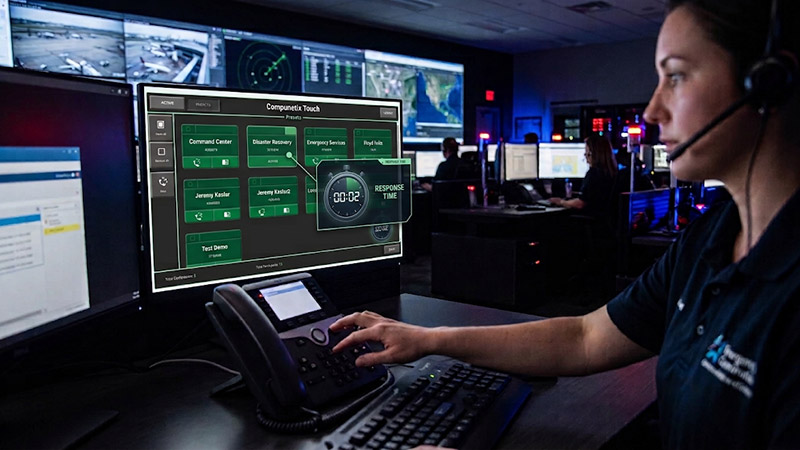
When an emergency occurs, communication systems are often judged by a simple question:
Can they notify the right people?
But in mission-critical environments, a more important question is often overlooked:
How quickly can they assemble the conversation?
For airports, emergency operations centers, utilities, military installations, and other critical operations, seconds matter. The faster stakeholders are connected, the faster information can be shared, decisions can be made, and resources can be deployed.
Most communication platforms can dial a list of contacts. The real difference lies in how they reach people when time is critical.
The Challenge: Reaching People, Not Phone Numbers
Emergency responders rarely have just one device. They may have a desk phone, mobile phone, station phone, vehicle phone, or other designated endpoint.
In a typical airport emergency, the goal is not to decide whether the ARFF Chief should be reached on a desk phone, mobile phone, or station phone. The goal is simply to reach the ARFF Chief as quickly as possible.
Yet not all blast dialing systems approach this challenge the same way.
Some systems treat every phone number as a separate directory entry, forcing operators to decide which contact point to use. Others dial participants sequentially, creating delays as unanswered calls must be exhausted before alternative numbers are attempted.
During routine communications this may be acceptable.
During an emergency, every unanswered call can delay the assembly of the response team.
Beyond Basic Blast Dialing
Compunetix ConferenceManager and CONTEX platforms were designed to reduce those delays.
ConferenceManager supports simultaneous blast dialing, allowing emergency conferences to be launched immediately while multiple stakeholders are contacted at the same time rather than one participant after another.
The platform also associates multiple dial-out numbers with a single participant record. Rather than managing separate entries for each device, organizations can maintain one contact while providing multiple ways to reach that individual.
If a participant doesn’t answer their primary number, ConferenceManager can automatically attempt alternate contact methods, helping ensure the focus remains on reaching the person rather than managing phone numbers.
The result is faster participant acquisition, simpler administration, and more efficient emergency conference assembly.
From Notification to Coordination
The most effective emergency communications systems do more than place calls.
They rapidly assemble the people responsible for assessing conditions, allocating resources, and coordinating response efforts.
Because in an emergency, success is not measured by how many phone numbers are dialed.
It is measured by how quickly the right people are connected and able to act.
How Fast Can Your Team Assemble?
If you’re responsible for emergency preparedness, crash notification, or operational continuity, consider:
- Does your system dial participants simultaneously or sequentially?
- How are alternate contact numbers handled?
- Can operators quickly determine who has been reached?
- How much manual intervention is required during an active incident?
The answers may reveal opportunities to improve both response times and operational readiness.
Learn how Compunetix ConferenceManager and CONTEX solutions help organizations assemble emergency response teams faster when every second counts.
“In an emergency, the difference between notification and coordination is measured in seconds.”
