
Colleges and universities have invested heavily in helping students access information.
Course schedules, registration tools, financial aid resources, campus services, and academic materials are readily available online. Students can find answers to many questions without ever stepping into an office.
Yet for many institutions, an important challenge remains.
Information may be accessible. Human assistance is often not.
When a student encounters a financial aid issue, needs advising support, has a registration problem, or simply isn’t sure where to turn, the path to help can still involve multiple emails, phone calls, transfers, and disconnected processes.
At a time when institutions are focused on improving student engagement, persistence, and success, many are taking a fresh look at a fundamental question:
How easy is it for students to connect with the people who can help them?
The Access Challenge
Most colleges and universities provide extensive student support resources.
The challenge is not a lack of services.
The challenge is access.
Students may not know which office handles their issue. They may reach the wrong department and need to start over. They may find themselves waiting for a response while an important decision remains unresolved.
These moments matter.
A registration question can affect course selection. A financial aid concern can influence enrollment decisions. An advising conversation can impact academic progress and retention.
Institutions work hard to provide support. The opportunity is making that support easier to reach.
As we’ve discussed with student affairs and advising professionals across higher education, a common theme continues to emerge:
Students cannot benefit from support they never access.
Why Human Connection Still Matters
The student services landscape is evolving rapidly.
Self-service portals, automated workflows, knowledge bases, and AI-enabled tools all have important roles to play. They can improve efficiency and help students find answers faster.
But not every situation can be resolved through information alone.
Students often face questions that involve unique circumstances, uncertainty, or multiple departments. In those situations, human interaction continues to provide something technology cannot fully replicate: the ability to listen, interpret, guide, and adapt.
The goal is not choosing between technology and people.
The goal is helping technology create more opportunities for meaningful human connection.
The Virtual Front Door
Many institutions are now exploring what some have begun calling a Virtual Front Door approach to student services.
The concept is straightforward.
Rather than asking students to navigate departmental structures, office locations, contact directories, and multiple communication channels, institutions provide a single point of entry where students can begin their journey and be guided to the appropriate resource.
It mirrors the experience students encounter when walking into a well-designed student services center on campus.
Students do not need to know how the institution is organized behind the scenes. They simply need a clear path to the right person.
As support models continue to evolve, many institutions see the Virtual Front Door as a way to combine digital convenience with the personal connection students value.
Supporting the Connected Campus
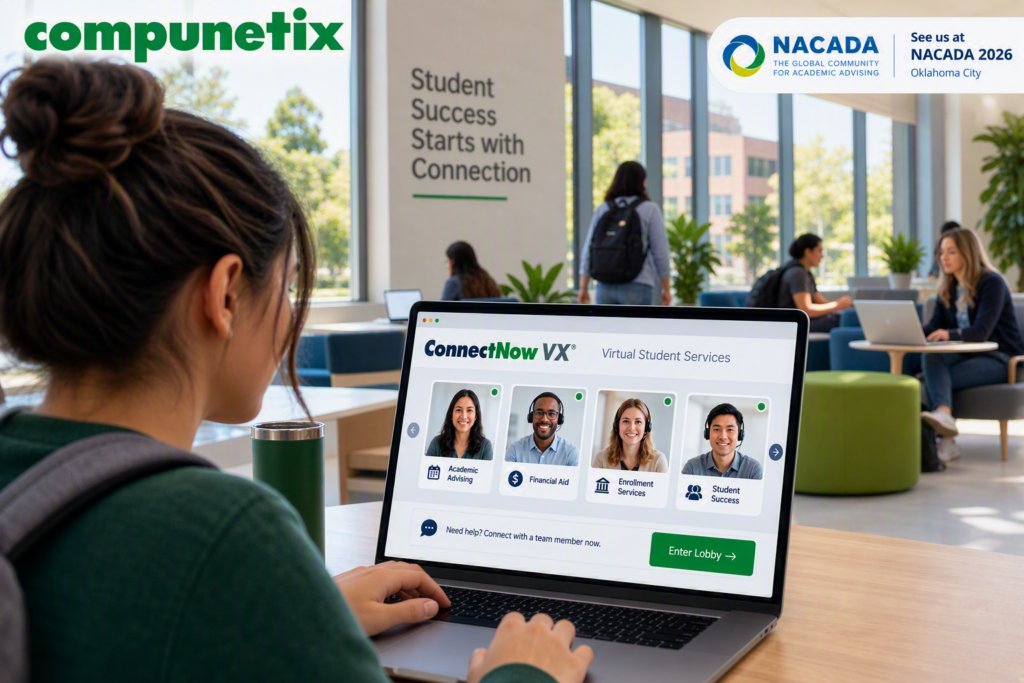
At Compunetix, we’ve been exploring this concept through ConnectNow® VX.
ConnectNow VX enables colleges and universities to create browser-based virtual lobbies where students can connect with advising, admissions, financial aid, enrollment services, tutoring, technical support, and other student-facing departments through a single digital entry point.
The objective is not to replace traditional student services.
The objective is to reduce friction between students and those services.
By simplifying access and supporting direct human engagement, institutions can create a more connected experience across the student journey.
Continuing the Conversation at NACADA
These topics will be front and center at the upcoming NACADA Annual Conference in Oklahoma City.
The pressures facing student support organizations continue to grow. Institutions are being asked to improve responsiveness, strengthen engagement, and create more seamless student experiences while operating within existing staffing and budget realities.
We’re looking forward to talking with advising leaders and student success professionals about how institutions are approaching these challenges and what role virtual student services may play in the future.
If you’ll be attending NACADA, stop by the Compunetix booth and share your perspective.
We’d welcome the opportunity to learn about your student support model, discuss the challenges your institution is facing, and explore new approaches for improving access to services.
Prefer to reserve dedicated time for a conversation? Schedule a meeting with our team during the conference. We’d be happy to provide a personalized demonstration of ConnectNow VX and discuss how a Virtual Front Door approach could fit within your student success strategy.
